
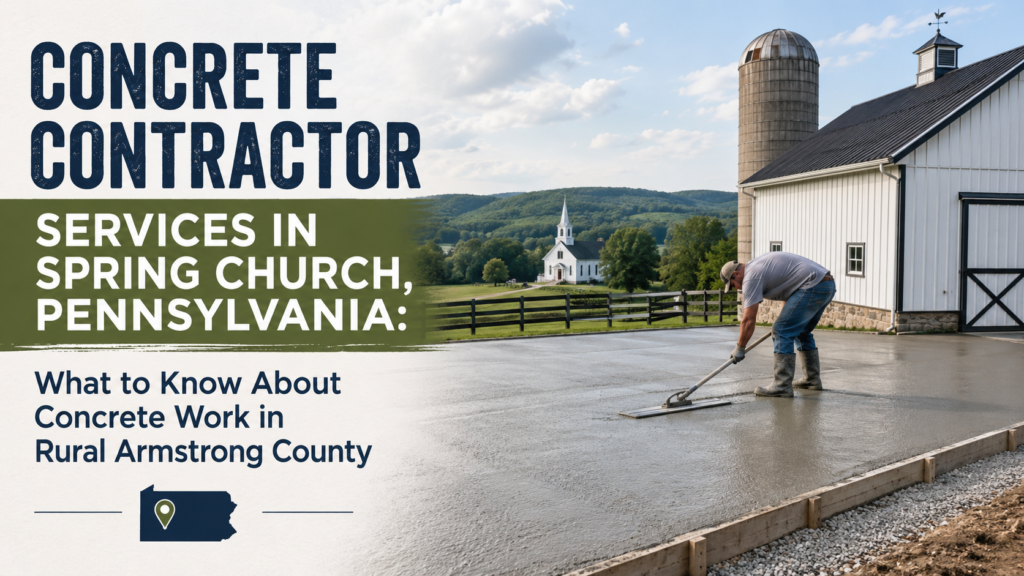
Spring Church is a small unincorporated community in Armstrong County, Pennsylvania, located along Pennsylvania Route 56 east of Apollo in the Kiskiminetas River valley. Like much of rural western Pennsylvania, it is characterized by rolling terrain, older residential stock, agricultural properties, and the practical infrastructure demands of a community where homeowners and property owners rely on local contractors for construction services. Concrete Contractor Spring Church the surrounding Armstrong County region provide a range of services that are foundational to property development, improvement, and maintenance in this area from driveway and sidewalk installation to foundation work, retaining walls, and agricultural site work.
What Concrete Contractors Do
Concrete contractors specialize in the installation of portland cement concrete for a wide variety of structural and non-structural applications. Unlike asphalt contractors who primarily work with flexible bituminous pavement, concrete contractors work with a rigid material that, when properly formulated and installed, provides exceptional durability and long service life. Services provided by concrete contractors in the Spring Church area include:
- Driveway installation and replacement: Concrete driveways are a durable option for rural properties where vehicle loads may be heavier than typical residential use.
- Sidewalk and walkway construction: Concrete provides a stable, long-lasting pedestrian surface for residential and commercial properties.
- Patio and outdoor slab installation: Concrete patios, porches, and outdoor living areas are common residential concrete projects throughout Armstrong County.
- Foundation work: Concrete footings, foundation walls, and basement floor slabs are standard in new residential and commercial construction.
- Retaining walls: Concrete retaining walls manage grade changes on the rolling terrain common throughout the Spring Church area.
- Curbs, gutters, and drainage structures: Concrete curbs, catch basins, and drainage channels are common in both private site development and municipal infrastructure work.
- Agricultural concrete: Barns, feedlots, equipment pads, and agricultural storage facilities frequently use concrete for their floors, aprons, and structural elements.
Western Pennsylvania’s Climate and Concrete Performance
Armstrong County experiences a four-season climate typical of Western Pennsylvania cold, snowy winters, wet springs, warm summers, and colorful autumns. This climate places specific demands on concrete installation. The freeze-thaw cycling that is a hallmark of Pennsylvania winters is among the most damaging natural forces acting on concrete. Water enters cracks and surface pores, freezes, expands, and breaks off surface layers in a process called spalling. Repeated over successive winters, this process can reduce a concrete surface to a rough, crumbling texture within a decade if the concrete was not properly air-entrained and designed for freeze-thaw exposure.
Air-entrained concrete concrete that contains a network of microscopic air bubbles incorporated through the mix design is the standard specification for all exterior concrete in Pennsylvania. These air bubbles provide space for freezing water to expand into without generating destructive pressure on the concrete matrix. Exterior concrete in Armstrong County should meet a minimum air content specification (typically 5 to 7 percent for flatwork exposed to deicing salts) and achieve a compressive strength of at least 4,000 PSI for residential flatwork applications.
Concrete Driveway Construction in Spring Church
Concrete driveways in the Spring Church area present both advantages and specific challenges compared to their asphalt counterparts. Advantages include greater resistance to petroleum product spills, no requirement for periodic sealcoating, and a lighter appearance that some property owners prefer. Challenges include higher sensitivity to freeze-thaw damage if improperly specified, greater difficulty and cost for repairs when cracking occurs, and longer initial cure time before the surface can be used.
Properly installed concrete driveways in Spring Church require:
- Adequate sub-base preparation: Excavation to remove organic material, sub-grade compaction, and installation of a well-compacted aggregate base to provide drainage and frost protection.
- Appropriate concrete specification: Air-entrained concrete with correct compressive strength, appropriate water-to-cement ratio, and resistance to freeze-thaw cycles.
- Control joint installation: Control joints grooves cut or tooled into the concrete surface direct cracking to predictable locations rather than allowing random cracking. Joints are typically spaced at intervals not exceeding the slab thickness in feet (a 4-inch slab should have joints every 4 feet or less).
- Curing: Concrete must be kept moist and protected from temperature extremes during the curing period at least 7 days for exterior flatwork. Proper curing allows the concrete to achieve its design strength and durability.
Retaining Wall Construction in Spring Church’s Terrain
The rolling terrain of Armstrong County creates frequent need for retaining walls on residential and agricultural properties in the Spring Church area. Sloped lots require grade management to create usable level areas, prevent erosion, and manage stormwater runoff effectively.
Concrete retaining walls for residential applications in Spring Church typically fall into two categories: poured-in-place concrete walls for taller, more heavily loaded applications, and segmental concrete block systems for shorter garden walls and landscape retention. For walls over 4 feet tall (measured from the bottom of the footing), Pennsylvania building code requires engineered design and permit review.
All retaining walls, regardless of type, must address drainage behind the wall. Water pressure (hydrostatic pressure) is one of the most common causes of retaining wall failure. Proper drainage through gravel backfill, perforated drain pipe at the footing level, and weep holes through the wall face relieves this pressure and prevents the wall from being pushed outward by saturated soil.
Agricultural and Rural Concrete Applications
Spring Church’s rural character means that concrete contractors in the area frequently work on agricultural applications that are less common in urban and suburban markets. Barn floors, livestock area pads, grain storage facility floors, equipment pads, and farm lane aprons are all concrete applications specific to agricultural properties.
Agricultural concrete must be specified for heavy loads and resistance to the chemical environment of farming operations. Livestock waste introduces ammonia and other compounds that can attack standard concrete. Agricultural floors should be specified with higher cement content, lower water-to-cement ratios, and surface treatments appropriate to the specific use. Proper drainage design in agricultural concrete is also essential sloped floors, gutters, and collection channels manage the liquid waste that is unavoidable in livestock facilities.
Conclusion
Concrete contractor services in Spring Church and Armstrong County address the full range of residential, commercial, and agricultural concrete needs of a rural Pennsylvania community. The region’s climate with its demanding freeze-thaw cycling and significant precipitation requires concrete that is properly specified for exterior exposure and correctly installed to achieve its design service life. Understanding what concrete work involves, what makes concrete perform well in Western Pennsylvania’s climate, and what distinguishes quality installation from inadequate practice gives Spring Church property owners the foundation to approach their projects with informed confidence.